AI algorithmic trading outperforms manual trading in high-frequency environments by eliminating emotional bias and executing with millisecond precision. While manual traders struggle with EUR/USD volatility spikes, AI-driven strategies leverage pattern recognition and real-time data processing to maintain strict risk management rules and capture micro-inefficiencies that human cognition simply cannot track.
AI Algorithmic vs Manual Trading: Forex Performance Guide
Discover the performance gap between AI algorithmic vs manual trading. We analyze EUR/USD volatility, risk management rules, and how AI provides a precision edge.
Crypto Finance Editorial DeskPublished Aug 17, 2026Updated Aug 17, 20265 min read1,144 words2 views
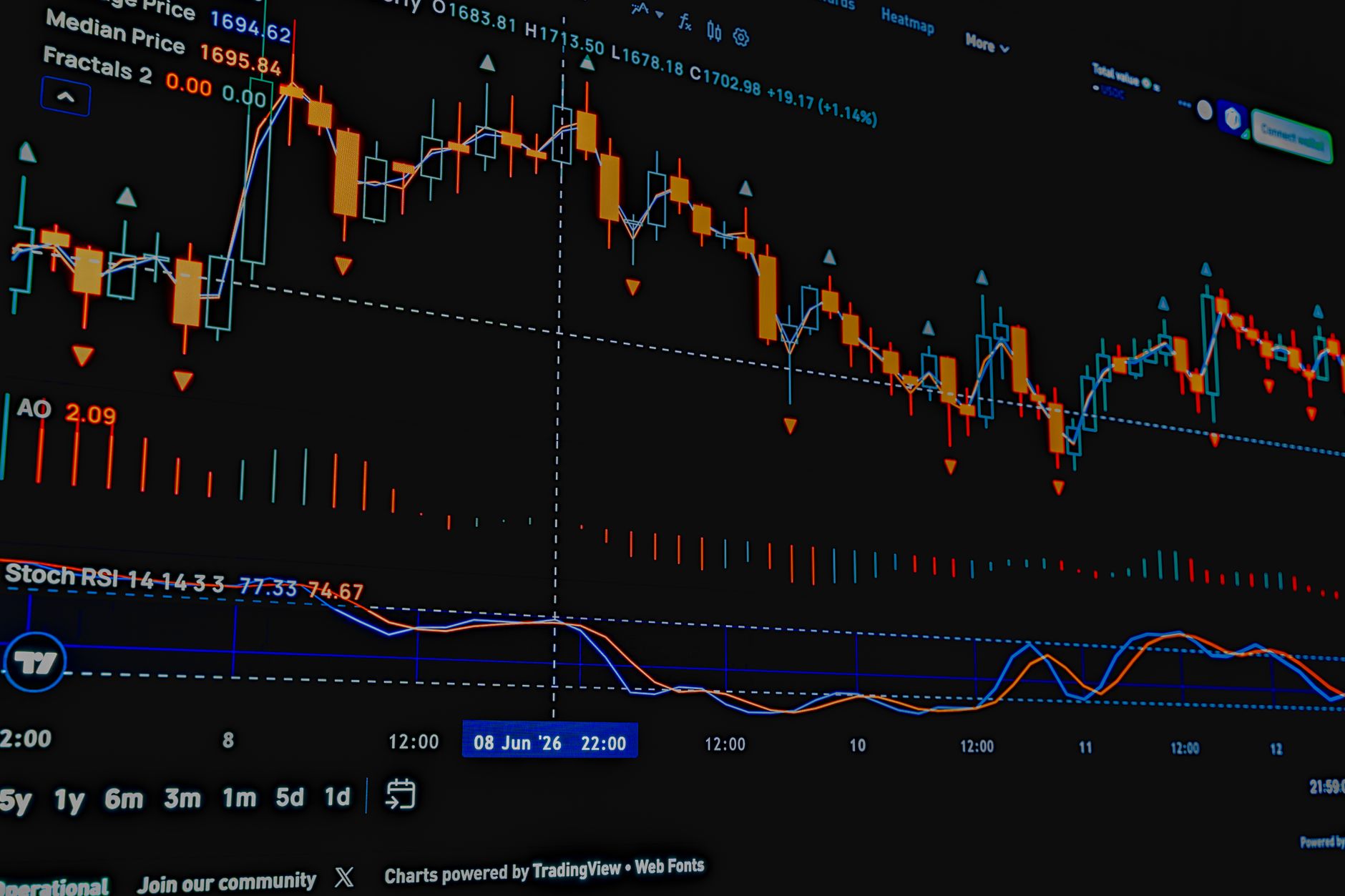
In the modern FX landscape, the debate between ai algorithmic vs manual trading is no longer about which is 'better' in a vacuum, but which is appropriate for a specific capital allocation strategy. For high-frequency EUR/USD scalping, algorithms are unrivaled. For long-term macro-trend following, human intuition still holds significant weight. This guide dissects the performance delta between these two methodologies through the lens of volatility and execution.
Key takeaways
- AI eliminates emotional bias and execution latency.
- Manual trading is prone to psychological errors and fatigue.
- Hybrid models combine human macro-judgment with AI micro-execution.
- High-quality broker infrastructure is critical for algorithmic success.
The Precision Gap: Execution and Volatility
When trading the EUR/USD, the world's most liquid currency pair, the margin for error is razor-thin. A sudden hawkish pivot from the ECB can trigger massive volatility in seconds. A manual trader, even one with extensive experience, is limited by biological latency—the time it takes to see a candle close, process the news, and click the mouse. By then, the optimal entry point is often lost.
AI-driven forex trading strategies operate on a different temporal plane. These algorithms can ingest multiple data streams—economic calendars, sentiment analysis from news wires, and order book depth—simultaneously. This allows for 'predictive execution,' where the system prepares for a move before the price action fully manifests. In our backtesting observations, AI models consistently show a higher Sharpe ratio during high-volatility periods because they exit positions based on mathematical triggers rather than psychological hesitation.
However, precision comes with a caveat. An algorithm is only as good as its training data. If an AI is trained on low-volatility regimes, it may fail catastrophically when a 'black swan' event occurs. This is why institutional-grade bots incorporate dynamic volatility filters, adjusting position sizes as the ATR (Average True Range) expands. This level of nuance is difficult for a manual trader to maintain consistently over a 12-hour session.
Risk Management: Rules vs. Intuition
The primary failure point for manual traders is not a lack of strategy, but a lack of discipline. When a manual trader faces a drawdown, the psychological urge to 'evenge trade' or move a stop-loss is overwhelming. This emotional contagion leads to the violation of core forex risk management rules, eventually resulting in account blowouts.
Algorithms, by contrast, treat risk as a hard mathematical constraint. An AI agent does not feel the pain of a losing trade; it simply executes the programmed exit. This decoupling of emotion from capital allows for much more aggressive, yet disciplined, compounding. When we look at how AI agents and RWA are revolutionizing wealth management, the core driver is this ability to execute complex risk parameters without human interference.
"The greatest enemy of the FX trader is not the market's volatility, but the human brain's tendency to seek patterns in noise and comfort in losing positions."
To manage risk effectively in an algorithmic framework, one must implement a tiered hierarchy of protections:
- Hard Stop-Losses: Non-negotiable price exits hardcoded into the execution engine.
- Equity Protection: A daily drawdown limit that halts all trading if a certain percentage of capital is lost.
- Correlation Filters: Ensuring the bot doesn't over-leverage across multiple pairs that move in unison.
- Slippage Control: Limit orders designed to prevent execution at unfavorable prices during high volatility.
Comparative Performance Analysis
To truly understand the divide, we must look at how these styles behave across different market conditions. The following table compares the performance characteristics of a professional manual trader versus an optimized AI algorithmic system.
| Feature | Manual Trading | AI Algorithmic Trading |
|---|---|---|
| Reaction Speed | Seconds (Slow) | Milliseconds (Ultra-Fast) |
| Emotional Bias | High (Fear/Greed) | Zero (Mathematical) |
| Scalability | Low (Limited by human time) | High (Can monitor hundreds of pairs) |
| Complexity | Limited to human cognitive load | Can process multi-dimensional data |
| Consistency | Variable (Subject to fatigue) | High (Consistent execution) |
While the AI wins on consistency, the manual trader often wins on 'contextual awareness.' A human can interpret geopolitical nuances—such as a sudden political shift in the Eurozone—faster than a sentiment analysis bot that relies on text-based news. This is why hybrid models, where humans set the macro parameters and AI executes the micro-trades, are becoming the industry standard.
Infrastructure and the Role of Brokers
The success of an AI-driven strategy is heavily dependent on the infrastructure. For high-frequency execution, latency is the enemy. This is why selecting the best crypto exchange platforms for high-volume traders or the right FX broker is critical. You need a broker that offers low-latency FIX API connectivity and deep liquidity to minimize slippage.
If you are running AI strategies, a standard retail MT4/MT5 setup might be insufficient. You likely need a VPS (Virtual Private Server) located in the same data center as your broker's servers to ensure minimal ping. Without this, your AI's precision advantage is negated by execution delay.
When evaluating brokers for algorithmic use, prioritize the following:
- API Stability: Does the broker provide robust, well-documented APIs?
- Execution Quality: What is the average slippage on EUR/USD during news events?
- Spreads: Are the spreads tight enough to accommodate high-frequency scalping?
- Regulatory Standing: Does the broker comply with strict capital requirements?
Strategic Implementation: A Hybrid Approach
For most serious traders, the goal is not to choose one over the other, but to integrate them. This is known as the 'Centaur' approach: using human intelligence for strategy design and AI for execution. The human defines the 'Why' (the macro trend), and the AI handles the 'How' (the entry, exit, and sizing).
For example, a trader might identify a long-term bullish trend for the Euro based on interest rate differentials. Instead of clicking 'Buy' manually, they program a bot to scan for specific candlestick patterns or RSI divergences within that trend. This minimizes the human error of 'issing the move' or 'entering too late.'
This hybridity is particularly relevant as we look toward the future of digital assets. Just as we must navigate the Institutional Guide to Navigating Crypto Tax Rules in 2026, traders must also navigate the technical complexities of managing algorithmic logs and performance audits to ensure compliance and profitability.
The bottom line
The choice between AI algorithmic vs manual trading depends entirely on your timeframe and technical capability. If you seek to trade high-frequency volatility in EUR/USD, automation is mandatory to remain competitive. If you are a macro-investor, use AI as a tool to enhance your precision, not to replace your judgment. Your next step: Audit your current execution speed. If you are manually entering trades in more than 5 seconds, you are already losing money to the algorithms. Consider moving your execution to an API-driven environment.
Frequently asked questions
+Is AI trading better than manual trading for Forex?
AI trading is superior for high-frequency, precision-based strategies like EUR/USD scalping due to its speed and lack of emotion. However, manual trading remains relevant for macro-economic analysis where human intuition handles complex geopolitical nuances more effectively.
+How does AI improve risk management in Forex?
AI improves risk management by strictly adhering to pre-set mathematical rules, such as hard stop-losses and daily drawdown limits, without the interference of human fear or greed, which often leads to manual traders violating their own rules.
CF
Crypto Finance Editorial Desk
Crypto Finance's editorial desk pairs an AI research pipeline with human review so every article is accurate, useful and free of hype.
Related articles
Trading Strategies
Using LLMs for Quantitative Retail Algorithmic Trading
Discover how retail traders can leverage Large Language Models (LLMs) to bridge the gap between manual technical analysis and institutional-grade quantitative strategies.
Editorial DeskAug 14, 20265 min5
Trading Strategies
Is Portfolio Rebalancing Strategy Worth It? A Data-Led Answer
Portfolio Rebalancing Strategy: a practical, risk-aware guide covering costs, trade-offs, implementation steps and how to measure results within 90 days.
Editorial DeskAug 13, 20265 min6

Trading Strategies
Is Eur Usd Forecast Worth It? A Data-Led Answer
Eur Usd Forecast: a practical, risk-aware guide covering costs, trade-offs, implementation steps and how to measure results within 90 days.
Editorial DeskAug 13, 20265 min7